Consumer forum cases in the Northeast take significantly longer to resolve than in metro cities. The gap is not about the merits, it is about how well the complaint is documented from day one.
APDCL (Assam Power Distribution Company Limited) supplies electricity to over 60 lakh consumers across Assam, making it one of the largest power distributors in the Northeast. Consumer disputes are a regular feature of any large utility, but data from the Assam Electricity Regulatory Commission consistently shows that grievance resolution in the state takes significantly longer than in urban-heavy states. The average AERC consumer forum case in Assam runs roughly three times longer than comparable cases in metro-served states like Maharashtra or Karnataka. The reason is not institutional bias or a lack of regulation. It is a documentation problem and it starts at the very first complaint.
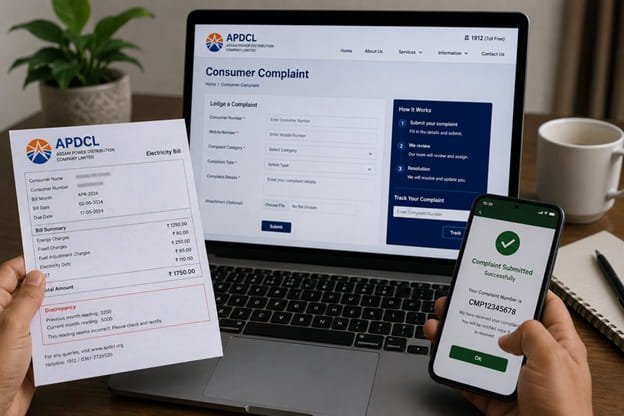
For consumers dealing with a disputed APDCL bill right now, the practical priority is two things: keep paying while the dispute runs and build a paper trail from the first day. One tool that helps on the payment side is Bajaj Pay, Bajaj Finance’s BBPS-powered service, which generates a timestamped receipt for every APDCL payment and stores month-on-month history exactly the kind of record that moves a complaint forward. More on that below. First, why does dispute resolution take so long?
Why dispute resolution in assam takes longer
Three structural factors drive the gap. The first is case volume relative to forum capacity. AERC handles grievances across a geographically large and dispersed consumer base. The ratio of active cases to adjudicators is higher than in states where multiple urban forums share the load.
The second factor is documentation quality at the first stage. When a complaint reaches AERC, it typically arrives with an incomplete paper trail missing prior correspondence, bills that were not retained, complaint reference numbers that were never recorded. Each gap adds a round of back-and-forth that extends the timeline. Cases that arrive with complete documentation every bill, every complaint, every APDCL response move faster. This is the factor consumers can actually control.
The third factor is geographic. Sub-division offices in rural Assam are further apart and more thinly staffed than their counterparts in Guwahati or Dibrugarh. A meter inspection that takes a week in a city can take three to four weeks in a district town and every delay at that stage extends the overall timeline before the case even reaches AERC.
The most common billing errors in Assam
The most common billing disputes in Assam fall into four categories:
- Wrong consumer category is the most financially significant: a household classified as commercial pays a higher tariff on every unit consumed, and the overcharge compounds across every billing cycle until it is corrected.
- Average load assessment errors affect consumers with motors or heavy equipment, where APDCL’s recorded connected load does not match what is actually installed.
- Estimated reading disputes are common in rural areas where physical meter access is difficult.
- Fixed charge errors where the demand charge applied does not match the sanctioned load on the consumer’s account are frequently missed because they appear as a line item rather than a unit price.
The three-step dispute path — and where the time goes
APDCL’s internal dispute process has three tiers. Most consumers who lose time do so by skipping the first tier or not documenting it properly before moving to the second.
| Forum | What it handles | How to reach it |
Step 1 — Start here |
||
| APDCL section / sub-division office | Billing errors, meter faults, estimated reading disputes, wrong consumer category classification. | Call 1912 or visit your nearest sub-division office. Submit a written complaint. Note the complaint reference number. |
Step 2 — If unresolved in 30 days |
||
| APDCL grievance portal / appellate authority | Complaints not resolved at sub-division level. APDCL is required under AERC regulations to respond within 30 days. | File at apdcl.org using your complaint reference number. The appellate authority is the next tier above sub-division. |
Step 3 — Formal escalation |
||
| AERC — Assam Electricity Regulatory Commission | Systemic issues, repeated overcharging, unresolved disputes after exhausting APDCL’s internal process. Consumer Forum cases handled here take an average of 3× longer than metro cities due to case volume and geographic spread. | File at aerc.gov.in
Submit with your complaint history, all bills, and APDCL’s written responses. The stronger your paper trail, the faster the resolution. |
AERC tariff orders and consumer regulations are available at aerc.gov.in. Tariff rates are subject to periodic revision.
How to build a complaint that moves fast
- Keep every APDCL bill from the point the dispute starts. Physical copies or downloaded PDFs both work. The key is an unbroken sequence with no missing months.
- Write every complaint, even the first one at the sub-division office. A verbal complaint leaves no trail. A written complaint with an acknowledged reference number is the foundation of everything that follows.
- Photograph your meter at the time of every complaint. Date-stamped meter photos are among the most effective pieces of evidence in a reading dispute.
- Log APDCL’s response time. If they promise a meter inspection within seven days and it takes 21, that delay becomes part of your case at AERC.
- Keep paying your bill in full throughout the dispute. Non-payment gives APDCL the right to disconnect regardless of an active complaint. Adjustments are credited in the billing cycle after the complaint is upheld.
Why your payment record is part of your dispute
A consistent payment history is not just financial housekeeping, it is evidence. It demonstrates that you are not disputing to avoid payment, you are disputing because there is a genuine error. At AERC level, this distinction matters. Consumers with clean payment records are taken more seriously and their complaints tend to move faster.
Making your APDCL bill payment through Bajaj Finance gives you that record without any extra effort. The service fetches your current APDCL outstanding by account number, processes the payment through the RBI and NPCI-regulated BBPS framework, and issues a timestamped receipt immediately. Your full payment history is available month by month in the app printable and formatted in a way that holds up as documentation. Payments go through via UPI, debit card, credit card, or net banking, around the clock.
How to pay your APDCL electricity bill on Bajaj Finance
- Same process on the website and the app (Google Play and App Store):
- Open the Bajaj Finance website or app (Google Play / App Store) and go to Bajaj Pay.
- Select Electricity and choose APDCL as your provider.
- Enter your consumer number and tap Fetch Your Bill.
- Confirm the amount and tap Proceed to Pay.
- Pay via UPI, debit card, credit card, net banking, or e-wallet. Confirmation arrives immediately.
Dispute resolution in Assam is slow by structure, not by design. The consumers who get through it fastest are the ones who treat documentation as seriously as the dispute itself from the first written complaint to the last payment receipt. That paper trail is the difference between a case that drags on for months and one that closes in a single cycle.

Anantha Nageswaran is the chief editor and writer at TheBusinessBlaze.com. He specialises in business, finance, insurance, loan investment topics. With a strong background in business-finance and a passion for demystifying complex concepts, Anantha brings a unique perspective to his writing.