
It is the last week of school, and the email lands: you are changing rooms. Suddenly years of books, bins, posters and half-used glue sticks need a plan.
Here is the short answer on how to move a classroom. Ask your school what it requires, photograph and sketch the room, pack by zone, number every box, and keep one “open first” box for daily supplies. Pack books in small boxes, take displays down carefully, and leave furniture and school property as your building directs. The steps below follow that order, so you can pack once and unpack in a day instead of a week.
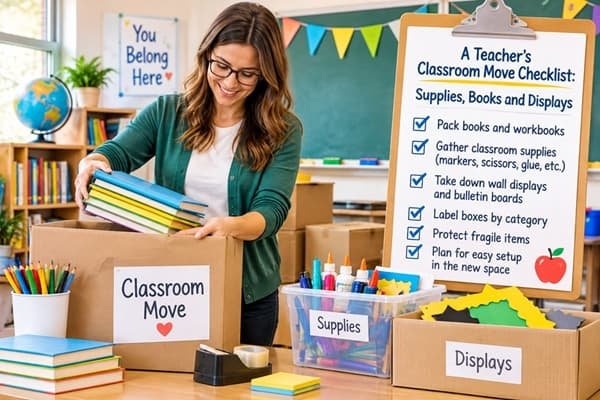
Check Your School’s Rules Before You Pack
Start by asking what your school or district requires, because the rules differ a lot from place to place. Some districts hand out boxes and tape, schedule custodians to move furniture, and ask teachers not to write on reusable boxes. Others expect each teacher to handle everything alone.
Get clear answers to these questions, ideally in writing:
- Who owns the furniture and equipment in the room, and what must stay?
- What are the deadlines for packing, key return and checkout?
- Who moves heavy pieces such as bookcases and file cabinets?
- Does technology need to be disconnected by your IT team?
If your district has an official staff move checklist, treat it as the final word over any blog post, this one included.
Photograph and Map the Room First
Before anything comes off a shelf, take wide photos of every wall, shelf and corner. Add close-ups of anything with a specific setup, such as a calendar area or a tangle of tech cords. These photos become your guide when you rebuild.
Next, sketch a simple floor plan of the new room. Mark where desks, tables, bookcases and the reading rug should go. Tape a copy to the new door and give one to whoever is moving furniture. A map stops people from guessing, and it saves floors from furniture dragged around while someone works out the layout.
How to Move a Classroom by Zone
Packing by zone means grouping items by where they live in the room, not by type. A zone is simply one area of the room, like the library corner or the supply table. Each zone gets its own colored tape or label, so boxes land in the right place on the other end.
Here is a simple set of zones to start with:
- Teaching wall: anchor charts, calendar pieces and posters, packed flat.
- Library: books, baskets and bin labels, kept together.
- Supply stations: pencils, glue, scissors and paper in clear bins with lids.
- Teacher desk: files, grade materials and chargers, which stay with you rather than going on the truck.
- Technology: projector, document camera and cords, handled the way your IT team directs, with each cord bagged and tagged to its device.
- Open first: tape, scissors, markers, sticky notes, cleaning wipes and a stapler.
Number every box and keep a master list on your phone, such as “Box 14: reading corner baskets and labels.” If a box goes missing, you know exactly what to look for. When your school bans writing on boxes, use colored tape or removable tags instead.
Sort Supplies Before You Box Them
Purge first, pack second. Anything you did not touch all year probably does not need a seat on the truck, and every extra box costs time at both ends. Make three piles: keep, donate or share, and recycle. A table outside your door or in the workroom lets colleagues pick up what you no longer need.
While you sort, separate your own property from school property. According to the National Education Association, educators spend roughly $500 to $750 of their own money each year on supplies for students (2023), so a good share of what is on your shelves may belong to you. Label personal items with your name or take them home, since other staff and workers often pass through rooms over the summer.
Check the school’s inventory too. You do not want to pack something the next teacher is supposed to inherit.
Pack Books in Small Boxes
Books get heavy fast, so choose small boxes and fill any leftover space with lighter items like paper. A box you cannot lift comfortably is a box that gets dropped. Rolling crates or a cart make long hallway trips easier.
Sort books before packing, whether by reading level, series or unit. Slip a sticky note or a rubber-banded index card on each stack so rebuilding the library takes minutes, not hours. Keep baskets and bin labels with the books they belong to.
Anyone carrying boxes should follow standard lifting guidance. The National Institute for Occupational Safety and Health advises lifting with your leg muscles, avoiding twisting, and checking the path before you lift. Look over your route for door stops and wet floors, and ask a colleague to share any awkward loads.
Take Down and Store Wall Displays Carefully
Photograph each board, then remove displays from top to bottom. Keep every set together with a sticky note naming the spot it came from. Store paper pieces flat in folders or large envelopes, because rolled and crushed posters rarely bounce back. Put scrap paper between laminated sheets so they do not stick together.
Before you re-hang anything, learn the fire rules for your new building. Limits on paper and fabric displays vary by state and by whether the building has sprinklers. As one example, the Minnesota State Fire Marshal explains that under the 2020 state fire code, combustible displays on corridor walls are limited to 20 percent of the wall area in buildings without sprinklers. Classroom walls may carry up to 50 percent of the room’s combined wall area. Ask your administrator which numbers apply to you.
This is also a good moment to retire tired displays. Moving is the easiest time to decide that last year’s bulletin board does not need a second life.
Know What to Leave Behind and When to Get Help
Leave the room the way you would want to find it. Empty the desk and cupboards, sweep up, and remove tape and putty from the walls unless your school says otherwise. Walk through the room with a custodian or administrator and ask them to confirm it is ready. Do not take school-owned furniture, projectors or shelving to the new room unless someone has approved it.
Some jobs are not worth doing alone. Large bookcases, file cabinets and shared storage may need to be taken apart, and teachers should not be hauling them. Your custodial team or facilities office is the first call. When a district or school brings in outside help for a bigger relocation, it may look at commercial movers for schools and offices, which typically handle disassembly and reassembly along with furniture and equipment relocation. Get the scope in writing, including who places furniture in the new room and who covers any damage.
Frequently Asked Questions
How far ahead should I start packing a classroom?
Start three to four weeks before the move. Pack the items you will not need first, like seasonal decorations, extra books and spare supplies. Keep daily materials out until the final week. Spreading the work over several weeks turns one exhausting weekend into a series of short, manageable sessions.
What should I pack first when moving classrooms?
Pack things you do not use daily: seasonal items, display pieces, extra books, and craft materials. Leave everyday supplies, student-facing materials and your desk contents for last. This order keeps your teaching running until the final days and means you are not digging through half-packed boxes for something you need tomorrow.
Should I label boxes by contents or by zone?
Use both. Mark each box with its zone, a number, and a short note about what is inside. Then keep a master list matching numbers to contents. The zone tells movers where the box goes, and the number lets you find a specific item without opening ten boxes in the new room.
How do I keep books from damaging my back or the books?
Use small boxes so the weight stays manageable, and do not overfill them. Fill gaps with paper so books do not shift. Use a cart or rolling crate for longer trips. Lift with your legs, keep the box close to your body, and ask for help with anything awkward.
What do I do with supplies I no longer need?
Sort them into donate, share and recycle piles. Set up a table outside your door so colleagues can take what is useful. Before you throw anything away, check your school’s policy, because items bought with school funds may need to be returned to the office or logged rather than tossed.
Who is responsible for moving classroom furniture?
In most schools, the district or building staff handle furniture, not individual teachers. Rules vary, so ask your administrator or facilities office what applies to you. Teachers are usually responsible for emptying furniture, packing their own materials, and labeling what belongs to them before furniture is moved.
Make the First Day in the New Room Easy
Set up in a sensible order. Place furniture according to your floor plan first, then connect technology, open your “open first” box, rebuild the library, and hang displays last. Compare each zone with your photos as you go so nothing ends up in a strange spot.
You do not need a finished room on day one. Aim for a space you can teach in, with the daily supplies within reach, and polish the rest over the following weeks. A calm, well-labeled move leaves you with energy for the students walking in.
Sources (for editor verification)
- National Education Association, “Why are educators still buying their own school supplies?” (2023) – https://neatoday.org/nea-today/all-news-articles/why-are-educators-still-buying-their-own-school-supplies
- National Institute for Occupational Safety and Health (CDC), “Materials Handling: Lifting and Carrying Toolbox Talk,” DHHS (NIOSH) Publication 2026-119 (2026) – https://www.cdc.gov/niosh/media/pdfs/2026/09/2026-119.pdf
- Minnesota State Fire Marshal Division, “Classroom Fire Safety for Teachers” (2020 Minnesota State Fire Code) – https://dps.mn.gov/divisions/sfm/fire-code/Documents/Fire-Code-Information-Sheets/Classroom-fire-safety.pdf

Anantha Nageswaran is the chief editor and writer at TheBusinessBlaze.com. He specialises in business, finance, insurance, loan investment topics. With a strong background in business-finance and a passion for demystifying complex concepts, Anantha brings a unique perspective to his writing.